


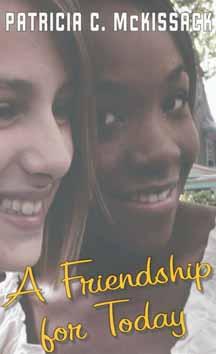
  | Full Text Reviews: Bulletin for the Center... - 04/01/2007 It’s 1954, and twelve-year-old Rosemary Patterson has to say goodbye to her beloved elementary school in the suburbs of St. Louis because the Supreme Court has ruled against segregation. She and her best friend J.J. are set to attend the same formerly all-white school when J.J. is stricken with polio, leaving Rosemary to brave the new school on her own. Her chief nemesis, a poor white girl with a bad attitude and a bigoted family, is also in her class, and it isn’t long before the two girls forge a friendship based on Rosemary’s unwillingness to ostracize Grace because of her poverty, and Grace’s reciprocal gesture of not taking a dare to call Rosemary the n-word. The school year proceeds smoothly thanks to the enlightened perspective of Rosemary’s teacher, and Rosemary is happy to finally get J.J. back just as Grace moves away. This Midwestern story of school integration is an interesting departure from Southern accounts of Sturm und Drang at the schoolhouse door; the racial problems that Rosemary faces are interpersonal and they are offset by people of good will, who represent the majority of the folks she encounters. More important are the friendships and Rosemary’s growing understanding of the difference between ones that last and the ones that are impermanent, a distinction made poignant by her parents’ divorce. Her rescue of a badly wounded cat provides a teachable extended metaphor for J.J.’s partial recovery, as well as a sentimental touch. According to an author’s note, the book is based on McKissack’s own experiences, which explains the occasional flashes of adult insight Rosemary demonstrates and the catalog of nostalgia that frames the beginning of chapters that mark new years. For the most part, though, Rosemary’s voice is fresh, credible, and engaging, and readers will relate to the pangs of making new friends and losing, albeit temporarily, old ones. KC - Copyright 2007 The Board of Trustees of the University of Illinois. School Library Journal - 06/01/2007 Gr 5-8-McKissack dishes up a palatable blend of fact and fiction in her semiautobiographical story of Rosemary Patterson's pivotal sixth-grade year (1954-'55). The landmark Brown v. Board of Education decision closed the doors of Rosemary's colored school in Kirkland, MO, and dispersed students into two white elementary schools. Determined to prove she does not need remediation, Rosemary excels academically and refuses to be racially intimidated or stereotyped. An unlikely friendship with mean Grace Hamilton, labeled "white trash" by snobby classmates, opens Rosemary's eyes to shared experiences of prejudice, parental strife, peer pressure, and loneliness. Both girls develop a mutual respect for the hardships they face. Rosemary gets emotional support and comfort from storekeeper Mr. Bob, an ex-Tuskegee Airman; her independent, enterprising seamstress mother; her fair-minded and compassionate teacher; and Rags, a rescued, injured cat that finally emits a "meow." As her parents grapple with marital problems and her polio-stricken best friend, J.J., struggles to walk again, Rosemary learns the value of tolerance and perseverance. A wealth of historical references, from civil rights to polio vaccine to early TV, is embedded in the narrative. Readers will enjoy the protagonist's spunky, resilient response to adversity and her candid, often amusing observations of human nature.-Gerry Larson, Durham School of the Arts, NC Copyright 2007 Reed Business Information. - Copyright 2007 Publishers Weekly, Library Journal and/or School Library Journal used with permission. Booklist - 02/01/2007 When her best friend contracts polio, sixth-grader Rosemary Patterson becomes the only black child in her newly integrated classroom. There, she forms an uneasy bond with Grace Hamilton, whose poverty leaves her as vulnerable to jeers as Rosemary’s dark skin: "Arkansas trash, and a porch monkey. . . . What next?" Closely modeling Rosemary’s story on her own experiences during the 1954–55 school year, McKissack represents the full spectrum of responses to desegregation—from the kind teacher who teaches tolerance to the bigoted principal who insensitively awards a coupon to a whites-only restaurant as Rosemary’s spelling-bee prize. The friendship between Rosemary and Grace never gains the prominence suggested by the title and cover image, and the novel’s quiet, episodic structure will deter some readers. But McKissack’s insights into "the two steps forward . . . one giant step back" nature of the civil rights struggle are valuable, whether children encounter them on their own or in a classroom, where the novel will poignantly extend character education and history curricula. - Copyright 2007 Booklist. Loading...
 |