

   | How the Ghost Army hoodwinked Hitler : the story of American artistry and deception in World War II Author: Siegel, Rebecca | |
| Price: $23.98 | ||
Summary:
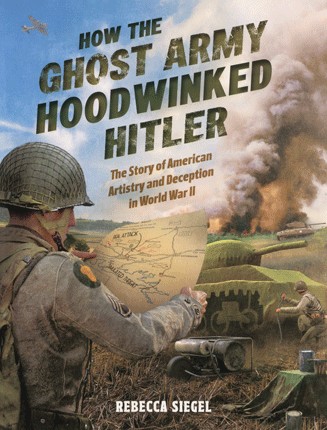
The unbelievable true story of the American soldiers who used inflatable tanks and fake radio broadcasts as weapons in World War II.
Reviews:
Kirkus Reviews (10/01/25)
School Library Journal (09/01/25)
Booklist (10/01/25)
Full Text Reviews:
Publishers Weekly - 08/04/2025 In this gripping historical exploration, Siegel (The United States Book) recounts the seemingly implausible story of how American soldiers used theatrical subterfuge to outsmart Nazis during WWII. On Jan. 20, 1944, the Ghost Army-a recently instated unit that leveraged deception as its weapon of choice-met for the first time. Its missions were top secret, and its goal was to distract the Axis Powers by using visual and audio props, including inflatable tanks and fake radio broadcasts. Utilizing crisp, detailed prose, Siegel paints a clear picture of the Ghost Army’s operations, as when they impersonated Allied forces to convince German soldiers that the units were retreating, while the primary divisions used the Ghost Army’s cover to gain the upper hand. Fascinating depictions of the disguises soldiers wore and the research they did to fulfill their roles ensnare readers’ attention, while empathetically rendered post-war particulars-such as the Allied Powers’ discovery of concentration camps-eschews sensationalism, never losing sight of the human cost of the hostilities and the suffering endured by civilians, refugees, and soldiers alike. It’s a necessary volume that showcases the incredible effort and tactical diversity it took to turn the tide of the war. Ample back matter and resources conclude. Ages 10-up. Agent: Jennifer Unter, Unter Agency. (Nov.) - Copyright 2025 Publishers Weekly used with permission.
School Library Journal - 09/01/2025 Gr 5–8—Inflatable tanks, guns, trucks, and aircraft; super-sized speakers blasting recordings of moving military equipment and other realistic sound effects; fake radio transmissions; and a small group of creative human soldiers. While this sounds like a list put together for a movie or video game, this combination worked during World War II as a real military unit, commonly referred to as "The Ghost Army." Employing theatrical elements worthy of a Broadway stage, this WWII unit successfully fooled German troops into thinking the Americans had a larger troop presence, as well as misleading them about American positions. Siegel employs a conversational tone to keep the narrative moving, weaving in a large amount of factual information. Choosing three soldiers for emphasis, she invites readers to connect with the men and their history. Focusing on the background of these men with research that includes author interviews, letters, memoirs, and declassified government documents provides the historical events with immediacy. Filling in the time line of the larger war for context demonstrates the role and impact of the Ghost Army missions. Their final assignment, helping displaced persons at the end of the conflict, allows the author to explore some related elements, such as concentration camps and the nuclear bomb. VERDICT Delving into a unique element of WWII, this book will be well received by students, teachers, and anyone interested in military strategy.—Lucinda Snyder Whitehurst - Copyright 2025 Publishers Weekly, Library Journal and/or School Library Journal used with permission.
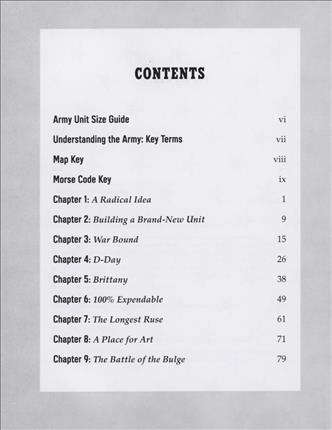
Booklist - 10/01/2025 While deception was once considered underhanded in war, during WWII it became an inventive way to save American troops and help win the war. Siegel researched declassified documents and photographs—many of which are included here—to deliver this detailed account of the 23rd Headquarters Special Troops, which came to be known as the Ghost Army. This small unit of ragtag soldiers, picked for their artistic, theatrical, imaginative, and innovative skills, was tasked with creating elaborate sets in the midst of war. With “dummy” trucks, inflatable tanks, prerecorded sound effects, bogus radio chatter, and other trickery, the Ghost soldiers could fool and misdirect Germans, allowing other American troops to carry out strategic missions. Focusing on a few of these Ghost soldiers, including Bill Blass (who became an iconic fashion designer) and Arthur Singer (who became an award-winning bird illustrator), Siegel takes readers chronologically, from D-Day to the Battle of the Bulge, through the Ghost Army’s biggest deceptions, with explanations of their significant impact. This distinct take on WWII is thoroughly sourced and absorbingly written. - Copyright 2025 Booklist.
