

  | Next shiny object Author: Talbott, Hudson | |
| Price: $23.28 | ||
Summary:
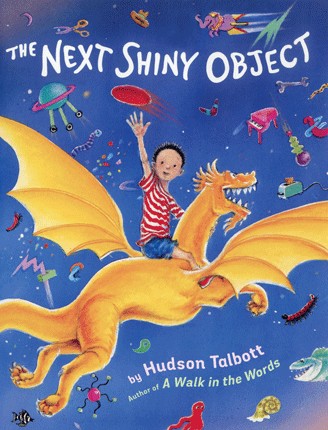
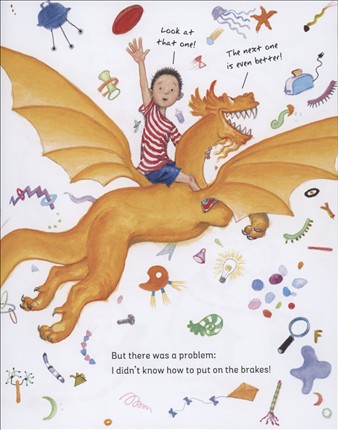
A child experiences the challenges and rewards of navigating the world with ADHD, his mind full of boundless curiosity that can make it hard to focus.
Reviews:
School Library Journal (04/01/26)
The Bulletin of the Center for Children's Books (A) (00/06/26)
Full Text Reviews:
School Library Journal - 04/01/2026 Gr 3–5—Curiosity and distractibility are conflated when an unnamed white protagonist grapples with the latter, which he personifies as his "personal dragon" because it is "always draggin'" his attention toward "the next shiny object." His difficulty controlling his focus will be familiar to many readers, and some will identify with the dejection he feels when he is unable to direct his attention toward school rules and behavioral expectations. His self-esteem is bolstered by his idol Leonardo da Vinci, who visits in a dream to show how curiosity is a gift that can "spark bright ideas," citing historical examples, such as Mozart, Galileo, and Einstein. By creating a confusing equivalence between distractibility and curiosity, the book implies without evidence that these historical figures faced similar struggles with attention and focus and perhaps minimizes the difficulty that these challenges bring to people's lives. When the frustrated protagonist asks, "What do I do when [curiosity] scatters my attention everywhere?" Leonardo has a response that may need explaining to younger children: "You're in charge. You can choose what to ignore and what to explore." If only it were that easy. VERDICT A book that appears to offer validation for those who struggle to ignore distractions and then says that the solution is to just ignore distractions.—Amy Reimann - Copyright 2026 Publishers Weekly, Library Journal and/or School Library Journal used with permission.
Publishers Weekly - 06/01/2026 A child learns that "a busy mind can be a beautiful thing" in this surreal outing from Talbott. Musing about curiosity, the light-brown-skinned young narrator likens it to the feeling of "a friend exploring with me, or a beast bouncing me around a pinball machine." But the constant movement feels more frustrating than fun as the beast, pictured as a dragon, jumps from one shiny object to the next. Only cycling brings the child a feeling of control and sustained interest. One night, drowning in a dream’s "sea of shiny objects," the child is rescued by Leonardo da Vinci, whose own long acquaintance with curiosity and distraction allow the child to reframe how to move through the world. Citing myriad creative thinkers, da Vinci offers a key piece of advice: using an established feeling of focus to "choose what to ignore and what to explore." Watercolor, colored pencil, and ink illustrations show the youth and dragon alongside arrayed ideas, while validating dialogue results in an upbeat picture of a child’s coming to terms with thinking outside the box. An author’s note concludes. Ages 4-8. (Aug.) - Copyright 2026 Publishers Weekly used with permission.
