

Bound To Stay Bound

View MARC Record
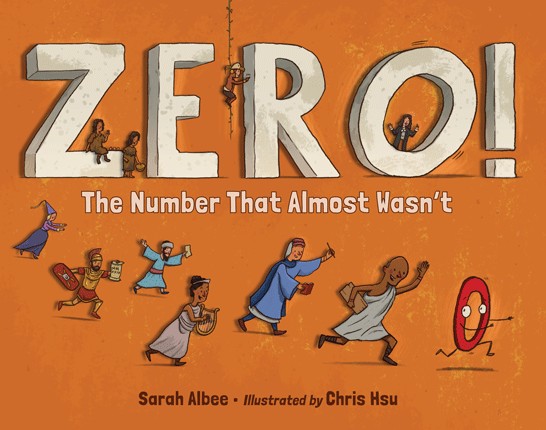
 Zero! the number that almost wasn't
 Author: Albee, Sarah

 Publisher:  Charlesbridge (2025)

 Dewey: 513.5
 Classification: Nonfiction
 Physical Description: [40] p., col. ill., col. map, 21 x 26 cm

 BTSB No: 047694 ISBN: 9781623544324
 Ages: 6-9 Grades: 1-4

 Subjects:
 Zero (The number)
 Cardinal numbers
 Mathematics -- History

Price: $22.58

Summary:
The history of the number zero is long, complicated, and interesting.

 Illustrator: Hsu, Chris

Reviews:
   Kirkus Reviews (+) (06/01/25)
   School Library Journal (+) (04/04/25)
   Booklist (+) (00/02/25)
 The Hornbook (00/05/25)

Full Text Reviews:

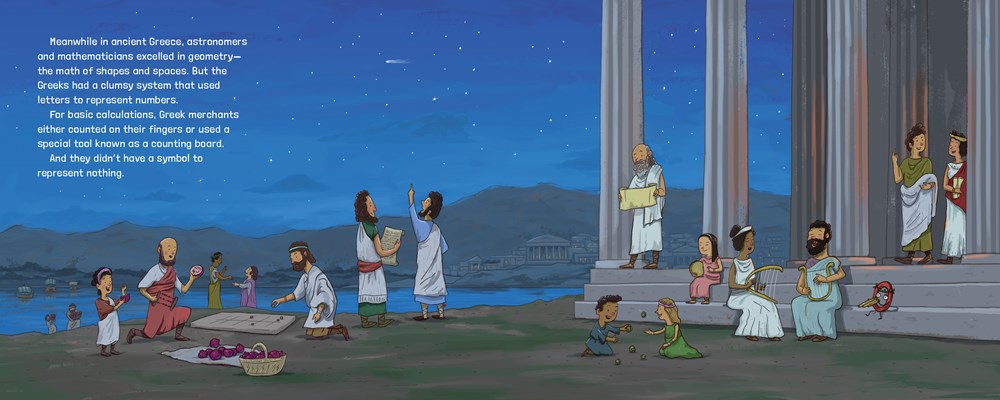
School Library Journal - 04/04/2025 Gr 1–4—Albee constructs a conversational, matter-of-fact narrative about the many years humans calculated on counting boards, used their fingers, put knots in strings and beads on lines, all for the lack of a—nothing. Until the Babylonians around 300 BCE, there was no such thing as a placeholder for single digits, tens, hundreds, and beyond. It's another 500–700 years before a mathematician in ancient India uses zero not only as a placeholder, but a number. Then comes adoption—not everyone is a fan of zero, including the Christians fighting a holy war against Muslims, suspicious of zero's Indian/Arabic associations. A brilliant unfolding and pacing of the narrative bring order to the near-misses and chaos of zero's origins, shored up by the various obstacles readers can discover in the time line. That calculus and algebra were also invented along the way feels nothing short of miraculous. Hsu's global scenes are cheerful and accessible, with pages that show people counting, adding, sorting, much as children do. It all adds up to an epic story of the little nothing that could, and did, launch or change engineering, modern physics, computing, and electronics forever. VERDICT Educators can build an entire lesson around zero, especially given the thoughtful resources and chatty time line provided in the back matter.—Kimberly Olson Fakih - Copyright 2025 Publishers Weekly, Library Journal and/or School Library Journal used with permission.

View MARC Record
Loading...
