

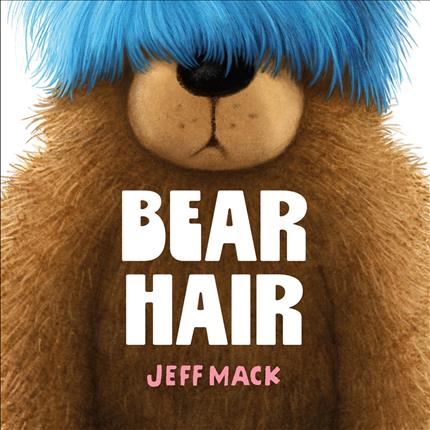
| Bear hair Author: Mack, Jeff | ||
| Price: $23.28 | ||
Summary:
A fuzzy brown bear and a fluffy pink hare disagree. About hair. Neither wants to go bare! Can they share?
Reviews:
Kirkus Reviews (+) (04/01/26)
School Library Journal (06/12/26)
Full Text Reviews:
Publishers Weekly - 04/13/2026 Riffing on the title words and their homophones, Mack’s simple, recombinatory narration yields comedic results in this raucous work. After a round-eyed brown bear discovers an electric-blue wig on the ground, "hair on bear" quickly becomes "hare on bear" with the arrival of a fuzzy pink bunny who steals the hairpiece, leaving behind a "bare bear." As tongue-twisting text proceeds through other possible orderings of the four rhyming words, the pair battle for the hair. Flatly colored minimalist backdrops place all the attention on Bear and Hare, capturing their furry selves with hundreds of individually drawn lines. After both animals have managed to sit on the prop (and on each other), Bear gains the upper hand and two new words-"tear" and "share"-are introduced for a friendship-producing conclusion. The duo’s sustained physical humor gives this heterograph-driven title a pleasing sense of mirth. Ages 4-8. (June) - Copyright 2026 Publishers Weekly used with permission.

School Library Journal - 06/12/2026 PreS-Gr 2—In this fun and zippy tongue-twister of a story, a brown bear and a bare hare tussle over who gets to wear a silly, bright blue hairpiece. With text limited almost entirely to two sets of homophones, bear and hare's antics are straightforward and goofy: bear admires his newfound wig, hare jumps on bear to snatch it away, bear steps on the hair to keep it from hare, and so on. While the rhyming, repeating language is fun to read, much of the story is carried by the energetic art. With simple compositions against white and solid-colored backdrops, Mack's textured illustrative style creates a tactile illusion where readers almost expect to feel real fur and hair when touching the page. To aid readers in keeping the homophones straight, each iteration appears in a different colored font that matches the color of the illustrated character or item. Although well intended, this feature may not be accessible to readers who are colorblind or have low vision. Despite these textual supports, homophones are a challenging language concept, and the twisting iterations of the same small group of words may perplex the earliest readers. As hare and bear eventually learn, some things are better shared; likewise, this book may be best facilitated as a read-aloud. VERDICT A first purchase for collections supporting story times and classroom sharing.—Kasey Swords - Copyright 2026 Publishers Weekly, Library Journal and/or School Library Journal used with permission.


