

Bound To Stay Bound

View MARC Record
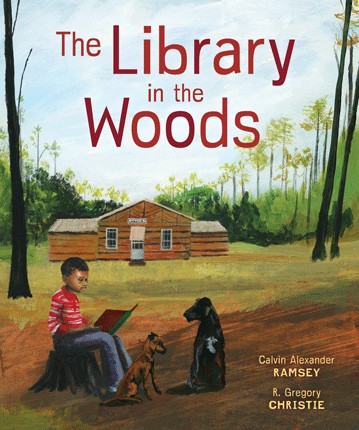
 Library in the woods
 Author: Ramsey, Calvin A.

 Publisher:  Carolrhoda (2025)

 Classification: Easy
 Physical Description: [34] p., col. ill., 29 cm

 BTSB No: 738261 ISBN: 9781541599123
 Ages: 6-9 Grades: 1-4

 Subjects:
 Libraries -- Fiction
 Books and reading -- Fiction
 African Americans -- Fiction
 North Carolina -- History -- 20th century -- Fiction

Price: $23.98

Summary:
When Junior moves to Roxboro, North Carolina, in 1959, new friends bring him to an incredible place: the Negro Library.

 Illustrator: Christie, R. Gregory
Accelerated Reader Information:
   Interest Level: LG
   Reading Level: 3.60
   Points: .5   Quiz: 556738

Awards:
 Coretta Scott King Illustrator Award, 2026
Coretta Scott King Author Honor, 2026

Reviews:
   Kirkus Reviews (06/01/25)
   School Library Journal (+) (10/24/25)
   Booklist (+) (12/01/25)

Full Text Reviews:

Other - 08/04/2025 After weather events destroy their crops two years running, young Junior’s Black family relocates to town. In Jim Crow-era Roxboro, N.C., Junior’s schoolmates tell him that "we have our own library"-a log cabin hidden in the woods, where "the books seemed to go on forever," Ramsey writes. Junior carefully chooses a title each for himself, his mother, and his father-and in doing so learns that his father does not know how to read. Christie’s rich acrylic illustrations employ smudgy textures across town and country landscapes in this personal-feeling work about adult illiteracy that ends with a moving reflection on intergenerational connection and different kinds of knowledge. An author’s note concludes. Ages 7-11. (Aug.) - Copyright 2025

School Library Journal - 10/24/2025 Gr 2–5—After Junior's family's farm is devastated for the second year in a row in 1959, his parents move them all to Roxboro, NC, with the hope of a more stable living in the city. Junior, who loved the country, struggles to adjust to the particulars of his new home, until some school friends introduce him to a gem: a library in the woods, for Black residents. This special place, featuring many books by Black authors, enchants Junior, who proudly brings home a book for himself and one book each for his mother and father. Through them, Junior learns more about his father's relationship with reading and makes an important bond. A generous author's note reveals to readers that this fictional story has roots in reality, including Ramsey's time as a child spent at the library in the book. Christie's striking and contemplative acrylic paintings, drifting effortlessly from spare but glowing landscapes to focused moments of emotion, are a perfect pairing for the slow-paced but affecting prose. VERDICT Quiet and powerful; purchase wherever picture book historical fiction is in demand.—Darla Salva Cruz - Copyright 2025 Publishers Weekly, Library Journal and/or School Library Journal used with permission.

Booklist - 06/01/2025 *Starred Review* A Black family maintains a farm in North Carolina until, after the crops are destroyed two years running, Junior’s father moves his wife and son into town. Although the library there excludes Black residents, Junior discovers a log cabin in a forest clearing, where he can borrow three books per visit. This library’s collection includes many books by Black writers. Junior chooses three books, one for each of his parents and one for himself. Puzzled when his father sits with his book every evening, but doesn’t open it, Junior asks his mother, who confides that his father cannot read. In writing the story, Ramsey was inspired by his childhood memories of watching his older brother Junior smiling, grimacing, and laughing while reading books, as well as the author’s own experiences with the nearby “library in the woods.” In an appended note, Ramsey explains that the story reflects its setting in the Jim Crow South, where literacy was often used to exclude Black residents from voting. The first-person narrative unfolds with simplicity, clarity, and emotional resonance. Christie’s illustrations, painted with acrylics, capture the tone of events as well as the look of the mid-twentieth-century setting. The use of juxtaposed colors is particularly effective in expressing the moods of the story. - Copyright 2025 Booklist.

View MARC Record
Loading...
