

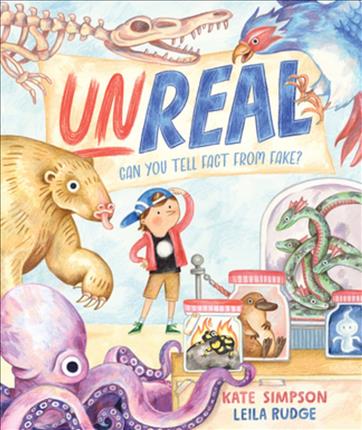
 | Unreal : can you tell fact from fake? Author: Simpson, Kate | |
| Price: $18.74 | ||
Summary:
An enthralling exploration of all the weird and wonderful creatures that may (or may not!) inhabit our world.
| Illustrator: | Rudge, Leila |
Reviews:
School Library Journal (10/31/25)
Booklist (10/01/25)
Full Text Reviews:
School Library Journal - 10/31/2025 Gr 2–5—A nonfiction book from Simpson (Ouch!) with mythical mysteries mixed in; this is a surefire delight for animal lovers and detectives alike. Page by page, with a young aspiring museum curator as their guide, readers discover new animals with extreme features—some of which are scientific facts, others of which are fictions that are meant to fool the audience. Discerning true information in today's age can be difficult, but it is a skill that one can practice. Simpson gives readers tips on how to decipher real from fake, with extraordinary animal categories as examples to practice on. Follow-up information is given on what animals were indeed real or fake, along with further guidance and tidbit facts. Illustrations depict these creatures in a realistic manner, offering an abundance of information on each page in a reader-engaging format. Back matter includes an index and a hidden mystery that might be missed on first glance. VERDICT A recommended purchase for all libraries, especially where unique animals are a popular topic.—Lindsey Morrison - Copyright 2025 Publishers Weekly, Library Journal and/or School Library Journal used with permission.
Booklist - 10/01/2025 There’s been a museum mix-up: displays from the Myths and Legends exhibit were accidentally brought to the Natural History wing, which features animals and plants. Now one of the installation workers is asking readers to help him sort through each section and identify the fake among the real specimens. To help readers glean fact from fiction, he presents six guiding questions to help discern if information is reliable. On topical spreads, such as Predators, Life Below Ground, and Plants and Fungi, short descriptions accompany five charmingly illustrated specimens with similar traits. The following double-page spread reveals which four are real and which one is not, with lengthier explanations of each. The brevity of the initial specimen descriptions offers a fun opportunity for students to research and practice evaluating information. Occasional supplemental text, such as on famous hoaxes from history, offers more examples of misinformation and how to spot it. Enchanting, lightly shaded watercolor-and-colored-pencil illustrations add levity to this important topic. Astute readers will notice progressive changes in the installation worker’s appearance and one final mythical creature. - Copyright 2025 Booklist.
